Several lawsuits have challenged how Home Depot charges and discloses its tool rental damage protection fee. As of the most recent court filings, none of these cases has resulted in a settlement, a refund fund, or a claims process consumers can actually join. Here is the accurate, current status, along with how to verify it yourself rather than take any article’s word for it, including this one.
What Is the Home Depot Damage Protection Fee?
Home Depot offers damage protection as an optional add-on for tool and equipment rentals, typically calculated as a percentage, around 15 percent, of the rental subtotal. It is meant to limit a customer’s financial liability if a rented tool gets damaged during the rental period.
What Do the Lawsuits Actually Allege?
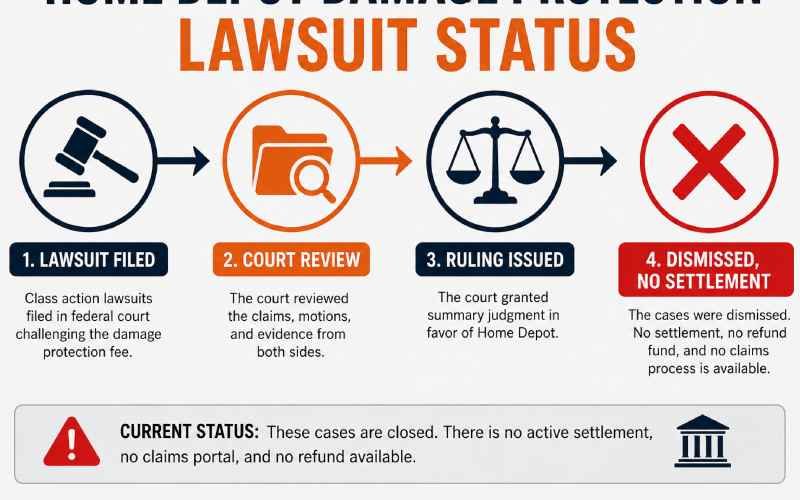
Two notable cases were filed in the U.S. District Court for the Northern District of Georgia. E&G Enterprise, Inc. v. Home Depot U.S.A., Inc. (Case No. 1:24-cv-03020), filed in July 2024, alleged the company overcharged customers on late fees and improperly calculated damage protection surcharges. Simmons v. Home Depot USA, Inc. (Case No. 1:25-cv-02409) claimed customers were defaulted into paying for optional damage protection without clear consent.
Both cases center specifically on tool and equipment rental transactions. They do not involve Home Depot’s product purchase warranties or extended protection plans on items you buy outright.
Is There Currently a Settlement or Refund Available?
No. The courts dismissed these cases or ruled for Home Depot. The courts granted summary judgment without approving any settlement. No court approved a class-wide refund for affected customers. No settlement fund currently exists for these cases. And No one has established a claims portal for payouts. Some websites still suggest consumers can file payout claims. Those websites now provide outdated or inaccurate information.
How to Verify This Yourself, Instead of Trusting Any Article
Most articles on this topic, including a lot of what currently ranks for this search, ask you to just take their word for the case status. You do not have to. Federal court records are public, and checking them yourself takes about five minutes.
- Go to PACER (pacer.uscourts.gov), the federal judiciary’s official case lookup system. A free account covers basic searches, and viewing a limited number of pages per quarter is free even without payment on file.
- Search by case number. For the Simmons case, that is 1:25-cv-02409. For E&G Enterprise, it is 1:24-cv-03020. Both were filed in the Northern District of Georgia.
- Check the docket entries directly. Look specifically for terms like “order granting summary judgment,” “dismissed,” or “settlement approved.” These entries tell you the actual current status in the court’s own words, not a summarized version filtered through someone else’s article.
- If a case shows an active motion for class certification with no ruling yet, that means the matter is still genuinely open. If it shows dismissal or judgment for the defendant with no appeal pending, that means it is functionally closed.
This same five-minute check works for verifying the status of any class action lawsuit you read about online, not just this one.
Why So Much of What’s Online About This Is Outdated
While researching this topic, a clear pattern showed up across many competing articles: several sites still present this as an open, ongoing opportunity to “sign up” or “file a claim,” language that made sense earlier in the litigation but does not reflect where the cases actually stand now. A few of these articles carry recent publish dates despite describing case status from months earlier, which suggests the content was refreshed cosmetically without the underlying legal facts being rechecked against the actual docket. That gap, between an article’s publish date and how current its legal information actually is, is exactly the kind of thing the verification steps above let you check for yourself in a few minutes.
Do Older Damage Waiver Cases Apply Here?
No. Some articles reference older cases from the 2000s that challenged damage waivers as effectively worthless. Those cases were unrelated to the current litigation and were not successful. Treat any article combining old and new cases into one narrative with caution, since it conflates separate legal matters with different outcomes.
What Should You Do If You Believe You Were Overcharged?
- Keep your rental receipts and any documentation showing the damage protection fee and how it was applied.
- Understand that with the primary federal cases dismissed, a class-wide remedy is not currently available through these lawsuits.
- If you believe you have an individual claim, consult a consumer protection attorney in your state, since remaining options would depend on your specific contract and state law, not the dismissed federal cases.
- Check the case status yourself using the PACER steps above before trusting any third-party summary, including this one.
Quick Answers
Can I still file a claim for the Home Depot damage protection lawsuit? Not through the primary federal cases, since they were dismissed without a settlement or claims process as of the most recent court records.
Does this affect Home Depot’s regular product warranties? No. These lawsuits are specific to tool and equipment rental damage protection fees, not product purchase warranties.
Is Home Depot still facing other unrelated lawsuits? Yes. Home Depot faces various separate legal matters over time, covering different issues entirely from this rental damage protection litigation.
Written by: CupOfJo Editorial Team
Last updated: August 25, 2026
Basis for this article: Researched using public federal court case filings, accessed directly through PACER, and cross-checked against legal news coverage of the litigation’s status.
What this article does not cover: This article is for informational purposes only and does not constitute legal advice. Consult a licensed attorney for guidance on your specific situation.
Corrections: If anything here is inaccurate or out of date, contact us and it will be corrected.
This piece is part of Cupofjo.org’s general Blog coverage, outside our core Fashion & Style, Food & Recipes, and Lifestyle & Home pillars.