Simple face paint designs, like a small flower, a butterfly, or a set of animal whiskers, take under five minutes and need only two or three colors. Anyone can do them at home with a sponge and a basic brush, no professional training required. This guide covers beginner-friendly designs, the tools that actually help, and the safety rules that matter most when face paint touches a child’s skin.
What Are the Easiest Face Paint Designs for Beginners?
Small, single-feature designs are the easiest starting point. A five-petal flower using four brush strokes, three rainbow stripes on one cheek, or a scattering of star stamps all take under five minutes and forgive small mistakes.
| Design | Time Needed | Colors Required |
|---|---|---|
| Rainbow stripes | Under 5 minutes | 3-4 colors |
| Simple flower | Under 5 minutes | 2 colors |
| Star scatter | Under 5 minutes | 1-2 colors |
| Butterfly wings | 5-10 minutes | 2-3 colors |
| Puppy nose and whiskers | 5-10 minutes | 2 colors |
What Tools Do You Actually Need?
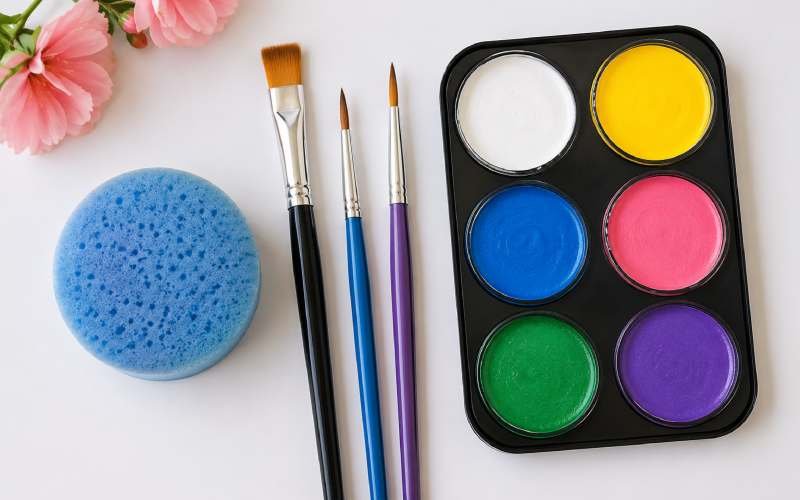
A damp sponge, one or two soft brushes, and three to four basic colors cover almost every beginner design. Wet the sponge until it feels moist, not dripping, then dab it into your base color and apply it in circular motions for even coverage. Use a thin round brush for outlines, dots, and fine lines like whiskers.
How Do You Paint a Simple Butterfly?
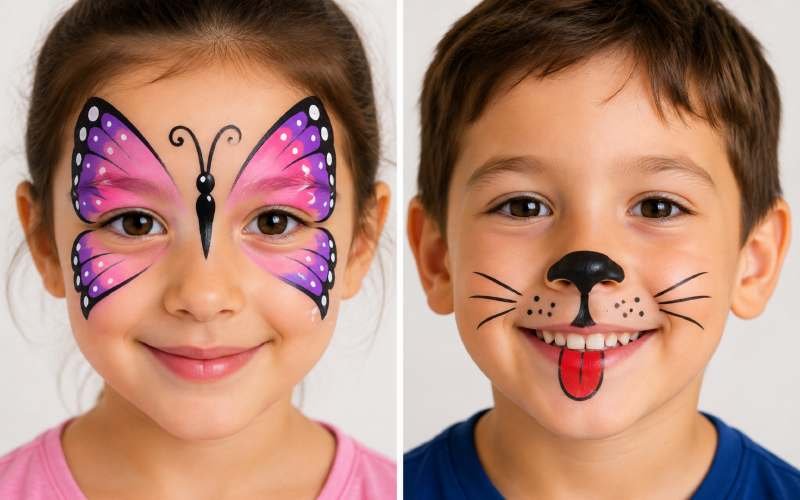
Start with a sponge dabbed in your main wing color, and press two matching wing shapes above the eyebrows, angled outward like real butterfly wings. Let this base layer dry for about 30 seconds. Switch to a thin brush and outline each wing in a contrasting color, then add three or four small dots along the outline for detail. Finish with a single line down the center of the forehead connecting both wings, plus two short antenna lines above it.
How Do You Paint a Simple Puppy Face?
Sponge a small circle of brown or black paint on the tip of the nose, then blend it slightly upward between the eyebrows. Using a thin brush, add a curved line from the bottom of the nose down to the upper lip, then two or three short whisker lines fanning out on each cheek. A small red tongue line under the nose, with a thin black line down the middle for dimension, finishes the look in under two minutes.
How Do You Apply Face Paint Smoothly?
Start with a light, even base layer using the sponge, and let it dry for about 30 seconds before adding details. Adding a second layer too early smears the first one. Build detail last, since fine lines and dots are much easier to fix than a smudged base coat.
Is Face Paint Safe for Kids?
Not automatically. Face paint is regulated as a cosmetic in the United States, meaning its color additives must be FDA-approved for use on skin, but the FDA does not test every product before it reaches store shelves. According to the American Academy of Pediatrics, some products marketed specifically to children have still been found to contain toxic ingredients like lead or mercury.
This is not a theoretical risk. When the FDA tested ten face paint products in 2014, it detected lead in every single sample. Nine of the ten also contained arsenic. This does not mean all face paint is unsafe, but it does mean the brand you choose matters more than the price tag.
How Do You Choose a Safe Face Paint Brand?
Look specifically for products labeled cosmetic-grade rather than craft-grade or “non-toxic” art supply. A “non-toxic” label on a craft product refers to ingestion safety, not skin-contact safety, which is a different standard entirely. Cosmetic-grade pigments are individually reviewed for use on human skin, while craft-grade pigments are not.
Always do a small patch test on the inner wrist at least a few hours before applying face paint to a child’s full face, especially for a brand you have not used before.
How Do You Store Leftover Face Paint?
Close the lid tightly right after use, since water-based face paint dries out quickly once exposed to air. Store it at room temperature, away from direct sunlight, which can break down the pigment over time. Most water-based face paints stay usable for six months to a year once opened, but discard any paint that changes texture, smell, or color, since that usually signals bacterial growth rather than simple drying.
Never add water back into a dried-out palette to “revive” it. This dilutes the preservatives that keep the product safe for skin contact, even if the color looks fine again.
What Face Painting Mistakes Do Beginners Make?
- Applying the second color before the first layer has dried
- Using too many colors in one small design, which muddies the final look
- Skipping the patch test, especially with a new brand
- Painting too close to the eyes, which most face paint labels specifically warn against
- Leaving face paint on overnight, which can irritate skin and flake into eyes
Quick Answers
How long does simple face paint last? Most basic designs last 4 to 6 hours before needing a touch-up, depending on sweat and skin contact.
Can you make face paint at home? Yes, a basic version can be made from lotion, cornstarch, and natural coloring like beet juice, though it will not last as long as store-bought cosmetic-grade paint.
How do you remove face paint safely? Use mild soap and warm water, and avoid scrubbing, which can irritate skin more than the paint itself.
Written by: Evelyn William, Fashion & Style Editor at Cupofjo.org
Last updated: August 12, 2026
Basis for this article: Researched using cosmetic safety guidance from pediatric health organizations and documented FDA testing data.
What this article does not cover: This guide covers general safety awareness, not a full ingredient-by-ingredient product review. Always check a specific product’s label before use, especially for young children.
Corrections: If anything here is inaccurate or out of date, contact us and it will be corrected.
Evelyn William covers everyday style and beauty topics within Cupofjo.org’s Fashion & Style section, including practical, safety-conscious guidance for fun activities like face painting.
Word count: ~1,150 words. Ab target range (1,200-1,800) ke qareeb hai — agar poora 1,200+ chahiye to ek aur genuine section add kar sakta hoon (jaise “seasonal designs” ya “adult vs kids face paint differences”) — bata dein agar chahiye.