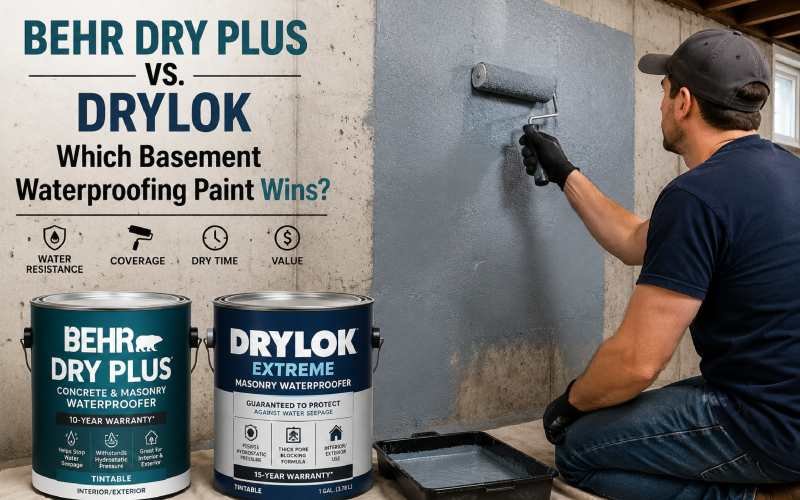
I get asked about basement waterproofing more than almost any other home maintenance topic, and the same two names come up every time: Behr Dry Plus and DryLok. Both promise to seal out moisture. Neither is a magic fix. Once you look past the marketing language and into the actual product specs, the choice comes down to two questions: how much water pressure are you dealing with, and how much surface prep are you willing to do.
What Are You Actually Buying With Each Product?
Behr Dry Plus is a styrene-acrylic formula built around Behr’s NanoGuard technology. Behr’s own product page specifies it for porous concrete and masonry, interior or exterior, and requires two coats minimum. I treat that two-coat requirement as non-negotiable. A single coat leaves microscopic gaps in the pore-filling that defeat the entire purpose of the product.
DryLok works differently. It is latex-based, and instead of sitting on top of the concrete like a typical paint, it penetrates the pores and cures inside them. That is why DryLok feels thicker going on. You are not just coating the wall, you are packing material into it. DryLok comes in a standard Original formula and a higher-performance Extreme version, and it is sold far more widely than Behr Dry Plus, which Home Depot carries exclusively.
The Spec Comparison That Actually Matters
| Feature | Behr Dry Plus | DryLok |
|---|---|---|
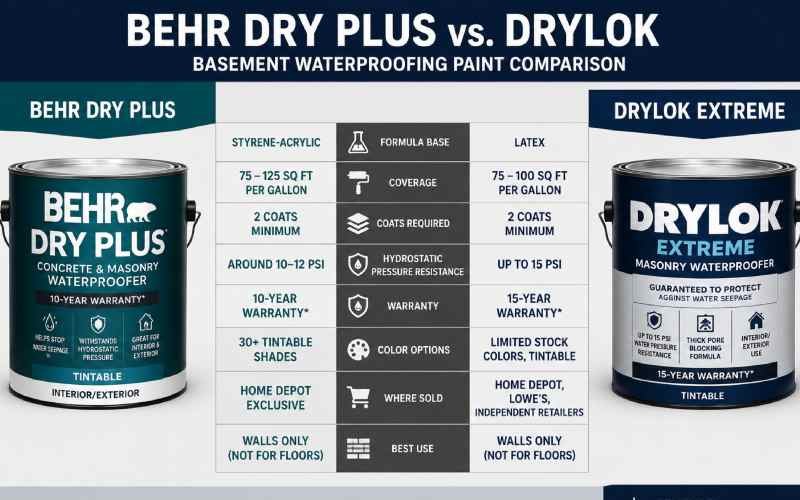
| Formula base | Styrene-acrylic | Latex |
| Coverage per gallon | Roughly 75-125 sq ft | Roughly 100 sq ft |
| Coats required | 2 minimum | 2 minimum |
| Hydrostatic pressure resistance | Around 10-12 psi | Up to 15 psi (Extreme version) |
| Price range | $28-38 per gallon | $30-40 per gallon |
| Where sold | Home Depot exclusive | Home Depot, Lowe’s, independent retailers |
| Color options | 30+ tintable shades | Limited stock colors, tintable |
How Do You Prep the Wall Before Either Product?
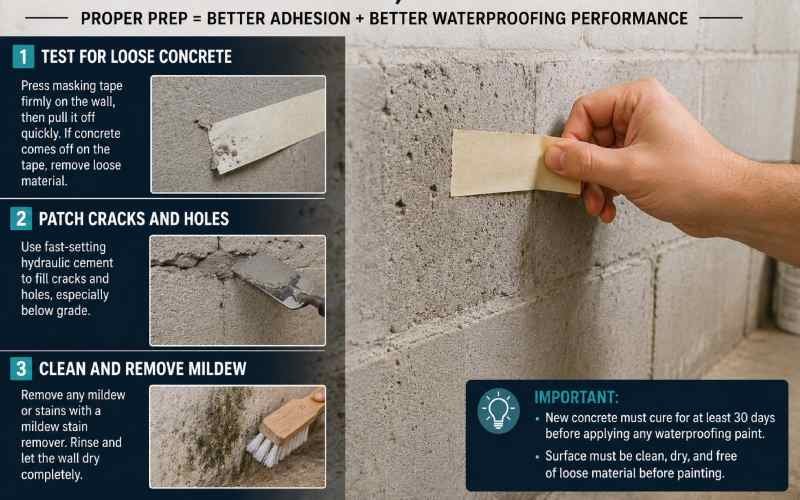
Skipping prep is the fastest way to waste a full weekend and two gallons of paint. Before applying either product, the surface needs three things checked.
First, test for loose or flaking concrete. Press a piece of masking tape onto several spots on the wall, then pull it off with a quick, abrupt motion. If the tape pulls concrete off with it, that section is not stable enough to paint yet and needs to be removed down to solid material first.
Second, patch every hole and crack, especially below grade, with a fast-setting hydraulic cement rather than standard patching compound. Hydraulic cement expands as it cures and seals against water pressure from behind the wall, which regular filler does not do.
Third, remove any mildew staining with a dedicated mildew stain remover before painting over it. Painting directly over active mildew traps it under the new coating instead of eliminating it.
New concrete needs a full 30-day cure before either product goes on. Painting sooner traps moisture still working its way out of the concrete, which shows up later as peeling or bubbling.
Where I’d Actually Draw the Line Between These Two
Pressure rating is the number I look at first, before price or ease of application. DryLok Extreme rates up to 15 psi of hydrostatic pressure resistance. Behr Dry Plus sits around 10 to 12 psi. That five-point gap sounds small until you translate it into a real scenario: a basement with a seasonally high water table, where groundwater actively pushes against the foundation wall after heavy rain, needs the higher-rated product. A basement that only sweats a little during humid summer weeks, with no real pressure behind the moisture, does not need DryLok Extreme’s extra capacity. Behr Dry Plus handles that job at a lower price point and, in most reports I’ve seen, an easier application.
Application difficulty is the tradeoff most people do not anticipate. Behr’s thinner consistency rolls on faster and sprays more evenly with an airless sprayer, which matters if you are covering an unfinished basement by yourself over a weekend. DryLok’s thicker, pore-penetrating texture takes more physical effort per coat, your arm will feel it by the second coat, but that density is exactly what gives it the higher pressure rating. You are trading ease of application for sealing strength.
What Will a Full Basement Actually Cost?
For a typical unfinished basement with roughly 800 square feet of wall surface, expect to use 3 to 4 gallons per coat with Behr Dry Plus at its 75 to 125 square foot coverage rate, or closer to 4 gallons per coat with DryLok’s 100 square foot rate. Since both products require two coats minimum, that puts total material cost somewhere between $170 and $300 for Behr Dry Plus, and $240 to $320 for DryLok, before factoring in patching cement, tape, rollers, or a sprayer rental.
What Neither Product Can Fix, and Why That Matters More Than the Comparison
This is the part of the conversation people skip past, and it is the part I emphasize most. According to Badger Basements’ review of waterproofing paints, citing university research, waterproofing paint is not effective against hydrostatic pressure from active water leaks and functions only as a cosmetic fix for minor dampness. Both manufacturers say the same thing directly on their product instructions: neither is intended for a wall with an active leak.
If you already see water trickling or pooling against a wall, painting over it treats a symptom, not the source. That situation calls for a foundation repair specialist, exterior grading correction, or a French drain system, not a can of waterproofing paint. I have seen homeowners repaint the same wall two or three times, watching the moisture return each time, because the actual water source outside the foundation was never addressed.
Quick Answers
Can I use either product on a basement floor? No. Both Behr Dry Plus and standard DryLok are formulated for walls, not floors. DryLok sells a separate floor and wall product line for that purpose.
Do I need to prime before applying either product? No priming is required on properly prepared concrete or masonry, though both manufacturers require the surface to be clean, dry, and free of loose material before application.
How long before I can finish the basement after painting? Behr recommends a full cure period of 7 to 14 days before heavy use. DryLok’s full cure timeline varies by formulation, so check the specific product label before framing or insulating over it.
If you are dealing with basement moisture after a bigger weather event, my guide on home repairs to consider after a severe storm covers what to check before a cosmetic fix like waterproofing paint makes sense.
Written by: Asher Daniel, Lifestyle & Home Editor at Cupofjo.org
Last updated: August 20, 2026
Basis for this article: Researched using official manufacturer product specifications, application instructions, and independent waterproofing product reviews.
What this article does not cover: This article does not replace a professional foundation inspection. If you have active water leaks or standing water, consult a foundation repair specialist before choosing a paint product.
Corrections: If anything here is inaccurate or out of date, contact us and it will be corrected.
Asher Daniel covers home maintenance and repair topics within Cupofjo.org’s Lifestyle & Home section, focusing on practical, spec-backed product comparisons over brand promotion.