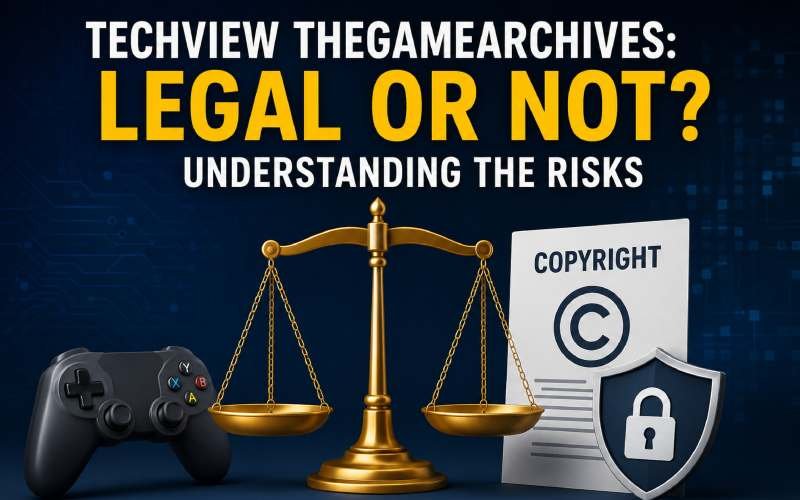
Sites like Techview TheGameArchives describe themselves as game preservation projects, offering downloadable ROMs alongside emulator recommendations. That framing does not settle the legal question. US copyright law treats ROM distribution very differently from how many sites present it, and the gap between the two has already cost real site operators millions of dollars.
What Is a ROM, and Why Does It Matter Legally?
A ROM is a digital copy of a game’s original code, typically pulled from a cartridge or disc. Copyright law protects that code the same way it protects a movie or a book. Distributing copies of it without authorization, even for free, without any profit motive, still counts as copyright infringement under US law.
Does Owning the Original Game Make Downloading a ROM Legal?
No, and this is the single most common misconception about ROM sites. Owning a physical cartridge does not give you the right to download a separate digital copy of that same game online. When you buy a physical game, you buy a license to play that specific copy, not the underlying code itself. Downloading a ROM from a website creates a new, unauthorized copy, regardless of what you already own.
Has This Actually Led to Real Legal Consequences?
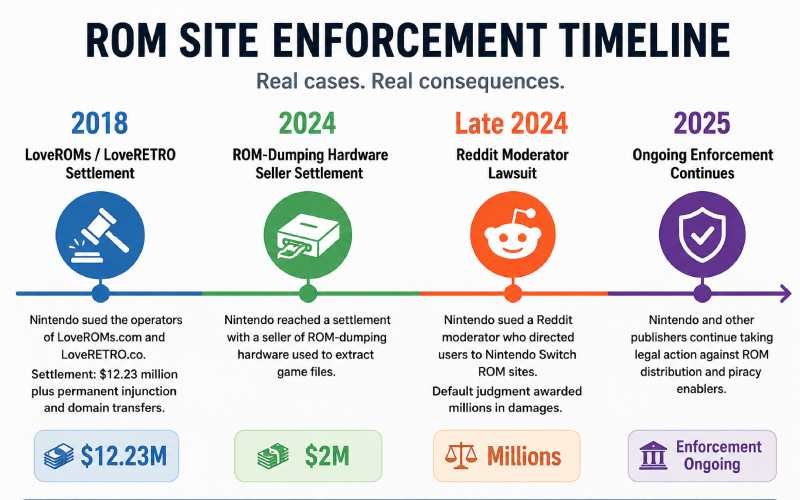
Yes, repeatedly, and the cases involve real money. In 2018, Nintendo sued the operators of two major ROM sites, LoveROMs.com and LoveRETRO.co, calling them “among the most open and notorious online hubs for pirated video games.” The case ended in a $12.23 million settlement, along with a permanent injunction and the surrender of both domain names to Nintendo.
That was not an isolated case. In 2024, Nintendo secured a $2 million settlement against a seller of ROM-dumping hardware. Separately, Nintendo pursued a Reddit moderator who directed users to Switch ROM sites, winning a default judgment worth millions more. These cases share a pattern: sites and individuals distributing ROMs, regardless of how they framed their purpose, faced serious financial and legal consequences.
Does “Preservation” or “Educational Use” Change the Legal Risk?
Not meaningfully, at least not in US courts so far. Sites that frame ROM access as historical preservation or educational research are making an argument, not stating settled law. Courts have not generally accepted this framing as a defense when a site’s core function is making copyrighted games downloadable to the public. The intent behind hosting the files does not change whether distributing them is authorized.
What Should You Look for When Evaluating a Site Like This?
| Signal | What It Suggests |
|---|---|
| Direct download links for full games | High infringement risk, regardless of framing |
| “Preservation” or “educational” language without licensing details | A stated intent, not a legal defense |
| No visible licensing agreements with publishers | Games are likely unauthorized copies |
| Emulator downloads only, no game files | Lower risk, since emulator software itself is generally legal |
What Are the Actual Legal Alternatives?
Several official channels now offer classic games without the legal uncertainty:
- Nintendo Switch Online includes libraries of NES and SNES titles for subscribers.
- PlayStation Plus Premium offers a rotating library of PS1, PS2, and PSP games.
- Official re-releases on Steam and other storefronts cover many classic titles individually.
- Physical retro hardware, like Analogue’s FPGA-based consoles, plays original cartridges through modern outputs, though at a higher upfront cost.
Quick Answers
Is emulator software itself illegal? No. Emulators, the software that mimics old hardware, are generally legal to download and use on their own. The legal risk comes from the ROM files, not the emulator.
Can I get in trouble just for downloading a ROM, not distributing one? Downloading still creates an unauthorized copy, which carries legal risk, though publishers have historically focused enforcement on the sites and individuals distributing files at scale rather than individual downloaders.
Is there any legal way to get ROMs for games no longer sold anywhere? This remains a genuinely unresolved gray area. Even so-called abandonware rarely has its copyright status formally cleared, so legal risk still exists even for older, out-of-print titles.
If you’re weighing legal risk in gaming more broadly, our guide on Marvel Rivals crossplay and account rules covers a different but related side of navigating platform and publisher policies.
Written by: CupOfJo Editorial Team
Last updated: August 19, 2026
Basis for this article: Researched using documented US copyright case law and publicly reported Nintendo enforcement actions.
What this article does not cover: This article does not provide legal advice for your specific situation. Copyright law varies by country, and this piece reflects US legal precedent only. Consult a qualified attorney for advice on your specific circumstances.
Corrections: If anything here is inaccurate or out of date, contact us and it will be corrected.
This piece is part of Cupofjo.org’s general Blog coverage, outside our core Fashion & Style, Food & Recipes, and Lifestyle & Home pillars.