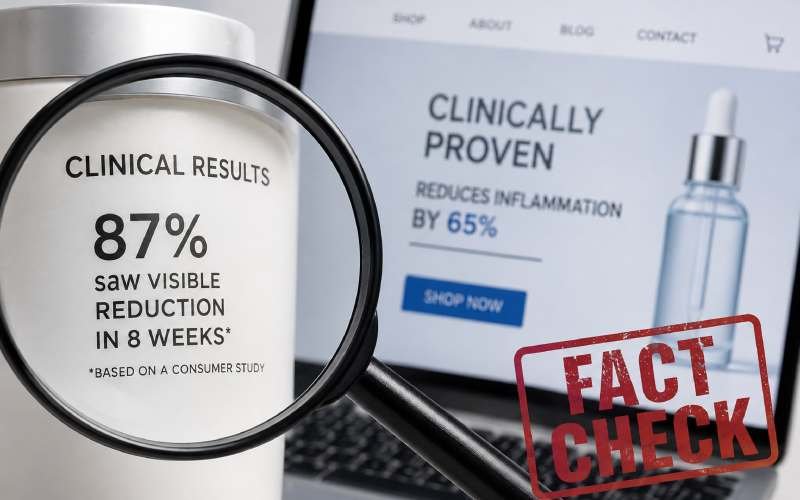
A skincare site claims its serum reduces inflammation by 65 percent. Another claims 89 percent of users see results in 8 weeks. Neither number links to a study, a journal, or a researcher’s name. This happens constantly, and once you know what to look for, spotting it takes seconds.
What Does a Real Clinical Claim Look Like?
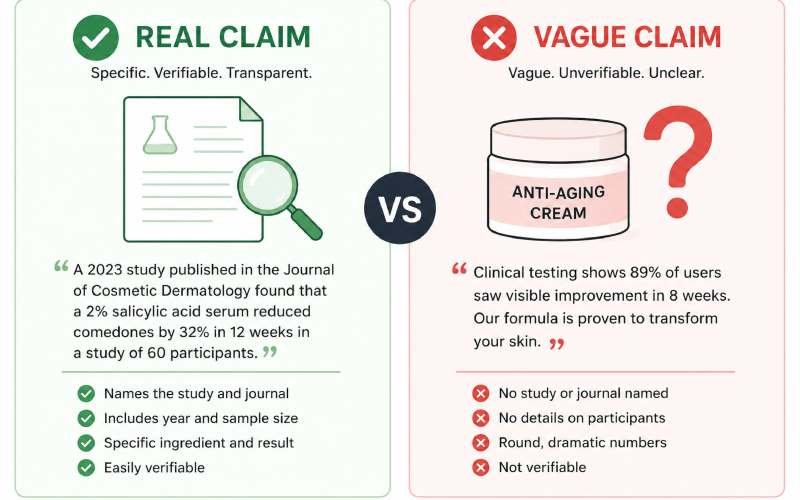
A genuine clinical claim names its source. It points to a specific study, a journal, a sample size, and often a date. A legitimate ingredient claim might read something like this: “a 2023 study published in the Journal of Cosmetic Dermatology found that a 2 percent salicylic acid formulation reduced comedones by a measured amount in a defined sample of participants.” That claim is checkable. You can look up the study yourself and see whether the marketing matches what the researchers actually found.
What Are the Warning Signs of a Fake Clinical Claim?
- A specific percentage with no source. Numbers like “65 percent” or “89 percent” sound scientific. Without a study name, journal, or researcher attached, there is nothing behind them.
- The same brand appears across multiple, nearly identical domains. One skincare research site, ClearSkinStudy, currently exists across at least five separate domains, each describing the platform differently: a clinical trial recruiter, an e-learning platform, a product line, a general skincare blog. A real research organization rarely needs five versions of itself with contradictory descriptions.
- Keyword-stuffed “About” or “Contact” pages. Some ClearSkinStudy domains include lines like “if you searched for clearskinstudy email info or clearskinstudy contact info, you’re in the right place,” written directly into the page copy. That kind of sentence exists to rank in search results. It is not written for a reader.
- Vague sourcing language. Phrases like “clinical testing shows” or “research proves,” with no name attached to who conducted the research or where it was published, should raise a flag every time.
What This Looks Like When You Actually Dig In
In practice, the giveaway is rarely the fake statistic itself. It is what surrounds it. A site built on real research usually links out, cites a lab or university, and lets you check its work. A site built on marketing copy tends to repeat the same three or four claims in slightly different wording across every page, without ever pointing anywhere you can verify. Once you notice that pattern once, it becomes easy to spot on the next site, and the one after that.
Has the FTC Actually Taken Action on Claims Like This?
Yes, and not just against small, obscure sites. In 2014, the Federal Trade Commission settled charges against L’Oréal USA over its Lancôme Génifique and L’Oréal Paris Youth Code product lines. The company had claimed its products were “clinically proven” to produce “visibly younger skin in just 7 days,” backed by specific percentages of users who reportedly saw results.
The FTC found L’Oréal could not support these claims with adequate evidence, despite the products selling for as much as $132 at upscale department stores. The settlement barred the company from making unsubstantiated gene-related claims across its broader product line going forward. If a company as large as L’Oréal faced enforcement for unsupported “clinically proven” language, a fabricated statistic on a smaller, unaccountable website deserves at least as much skepticism.
How Do You Verify a Skincare Claim Yourself?
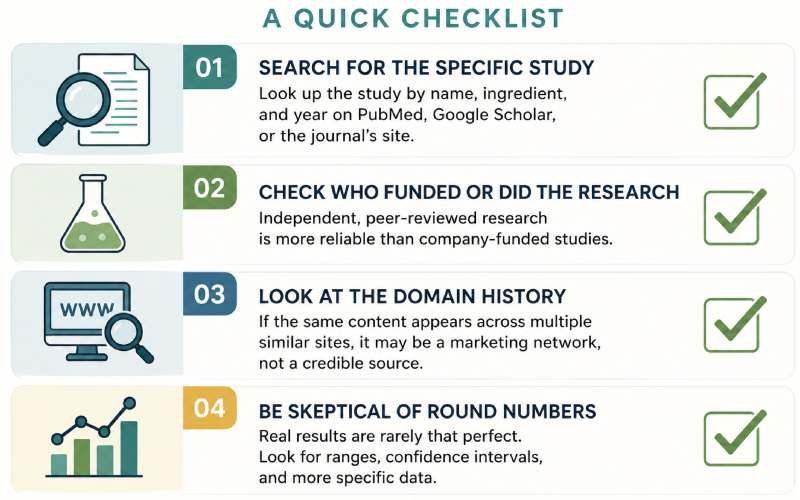
- Search for the specific study. If a site cites “a 2024 study,” search for it by name, ingredient, and year. A real study usually turns up on PubMed, Google Scholar, or the journal’s own site.
- Check who funded or conducted the research. Independent, peer-reviewed research carries more weight than a study run and published by the company selling the product.
- Look at the domain history. A quick search for the brand name alone often reveals whether the same content appears duplicated across several near-identical sites, a strong sign of a marketing network rather than a single credible source.
- Be skeptical of round, dramatic numbers. Real clinical results rarely land as cleanly as “85 percent” or “89 percent.” Genuine studies tend to report ranges, confidence intervals, or more specific figures instead.
Why Does This Matter for Skin Health Decisions?
Skincare choices, especially for conditions like acne, eczema, or sensitive skin reactions, work best when based on accurate information. A fabricated statistic can push someone toward a product or routine based on results that were never actually measured. That delay, chasing a fake number instead of getting real treatment, is the actual cost. If you are dealing with a persistent skin condition, a licensed dermatologist remains a far more reliable source than any single website’s claimed statistics.
Quick Answers
Is it illegal for a company to publish fake clinical statistics? In the United States, the FTC prohibits deceptive advertising claims, including unsubstantiated health claims, and has a documented history of enforcement action against companies of all sizes, from major brands like L’Oréal to smaller marketers.
Does having a professional-looking website mean the claims are real? No. Clean design is not evidence of accurate information. It is often used deliberately to build false credibility.
Should you avoid a brand entirely if you spot one fake statistic? Not necessarily, but it is a reason to verify every other claim the site makes rather than taking the rest at face value.
For more guidance on evaluating marketing claims before you trust them, our piece on what to check before hiring an Instagram growth agency covers a similar verification approach in a different industry.
Written by: CupOfJo Editorial Team
Last updated: August 17, 2026
Basis for this article: Based on a direct review of publicly available skincare marketing sites and documented FTC enforcement actions.
What this article does not cover: This article does not provide medical advice for any specific skin condition. Consult a licensed dermatologist for personalized treatment guidance.
Corrections: If anything here is inaccurate or out of date, contact us and it will be corrected.
This piece is part of Cupofjo.org’s general Blog coverage, outside our core Fashion & Style, Food & Recipes, and Lifestyle & Home pillars.