
Your best friend just asked you to officiate their wedding, and now the panic has set in. You have never done this before, and you are not sure where to start. Get the paperwork wrong, and their marriage might not even be legal. Get the ceremony wrong, and it is the one part of their wedding day everyone remembers for the wrong reasons. This guide breaks the entire process into clear steps, from ordination to the final signature on the marriage license.
What Does It Actually Take to Officiate a Wedding?
Officiating a wedding means two things at once. You lead the ceremony, and you make the marriage legally official. Every state requires a wedding to include two core elements: a declaration of intent, where the couple states they want to marry each other, and a pronouncement, where you officially declare them married.
Everything else in the ceremony is flexible. Readings, unity rituals, and personal vows are optional add-ons the couple can choose. The two legal elements are not optional. Skip either one, and the ceremony does not count.
How Do You Get Ordained Before the Big Day?
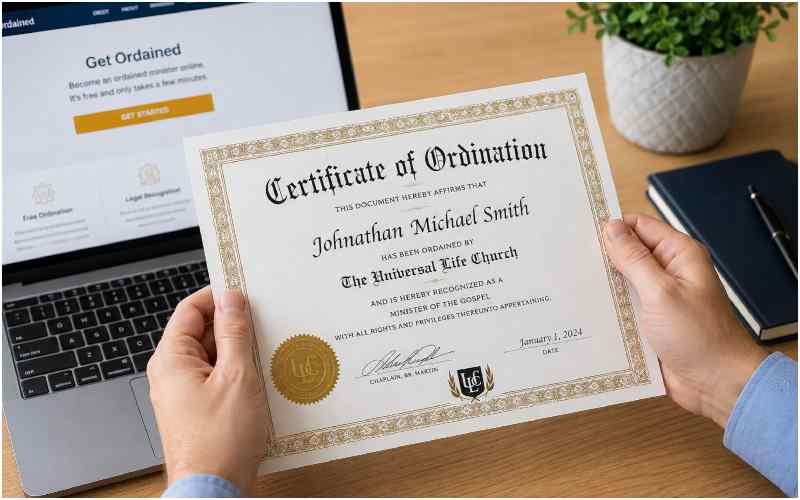
Most first-time officiants get ordained online through organizations like the Universal Life Church or American Marriage Ministries. The process usually takes a few minutes and often costs nothing for basic ordination.
Ordination alone does not guarantee you can legally officiate everywhere. Some states also require you to register with a local clerk’s office before the wedding. New York is one example. Start this process at least a month before the wedding date, since some county offices process paperwork slowly.
Does Every State Accept Online Ordination?
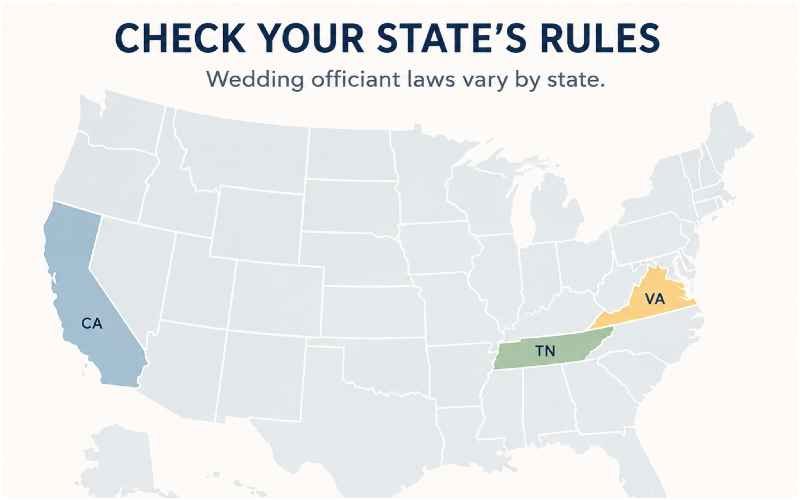
Most states do, but a small number have pushed back on it. Tennessee passed a law in 2019 that attempted to ban online-ordained ministers from performing legal marriages. Federal courts blocked the law from taking effect, and by 2023, Universal Life Church ministers received court assurances that their right to officiate in Tennessee would continue to be respected. Virginia has also restricted recognition of online ordination in some counties.
| State | Online Ordination Status | What to Do |
|---|---|---|
| Most states | Generally accepted | Confirm with your county clerk before the wedding |
| Tennessee | Legal challenge resolved in favor of online-ordained ministers as of 2023 | Bring proof of ordination and check current county guidance |
| Virginia | Restricted in some counties | Contact the specific county clerk directly before proceeding |
This table reflects the general legal landscape as of this article’s last update. Marriage law can change, and NPR reported extensively on the Tennessee dispute as it unfolded, which is worth reading if you want the full background. Always verify current rules with your county clerk regardless of what any article, including this one, tells you.
How Do You Write a Ceremony Script Your Couple Will Love?
A wedding ceremony script needs four parts: a welcome, a short reflection on the couple’s relationship, the vows and ring exchange, and the pronouncement. Keep the welcome brief. Guests are there to see the couple, not to hear a long introduction.
Ask the couple how personal they want the ceremony to feel. Some couples want their love story told in detail. Others prefer a short, simple ceremony without much personal narrative. Write the script around their answer, not around what you think a wedding should sound like.
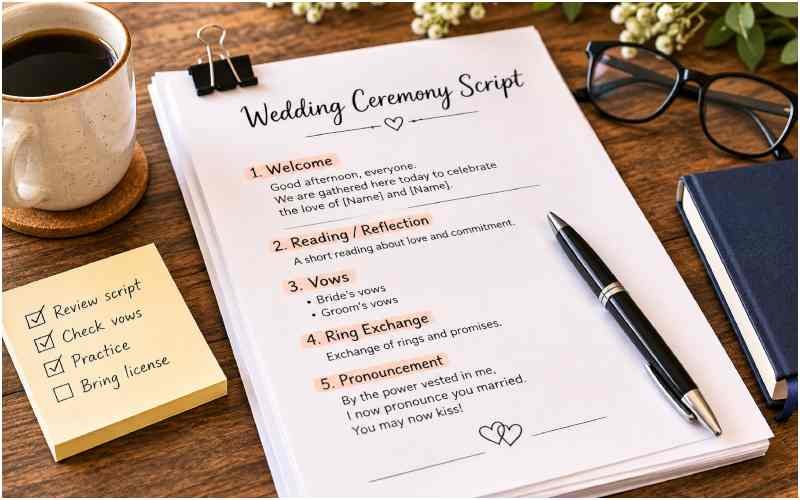
Read the full script out loud at least three times before the wedding. Reading silently hides awkward phrasing that becomes obvious the moment you say it aloud.
What Should You Do in the Final Two Weeks Before the Wedding?
Confirm the exact ceremony order with the wedding planner or the couple directly. Ask whether a microphone will be used, and test it beforehand if possible. Print two copies of your script: one for you, and a backup in case something happens to the first.
Bring the marriage license itself to the ceremony if the couple has already obtained it. Confirm ahead of time who is responsible for bringing it, since a missing license on the day cannot be fixed on the spot.
What Happens Right After You Pronounce Them Married?
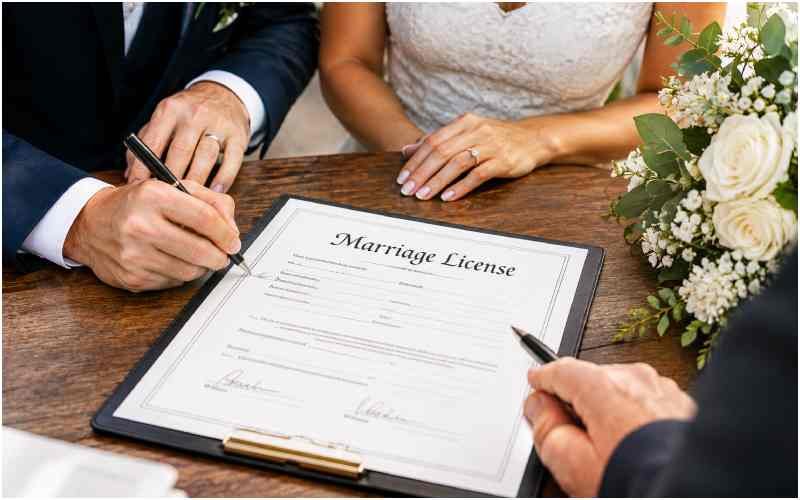
The ceremony is not finished when you say “I now pronounce you married.” The marriage license needs signatures from you and the required witnesses immediately afterward. Do not let this step get lost in the celebration.
Once signed, the license needs to be filed with the county clerk’s office, usually within a set number of days after the ceremony. Some officiants mail it directly. Others hand it back to the couple to file themselves. Confirm who is responsible for this step before the wedding day, not after.
Wedding Officiant Checklist
| Timeline | Task |
|---|---|
| 6-8 weeks before | Get ordained and confirm your state and county’s specific requirements |
| 3-4 weeks before | Meet with the couple to discuss ceremony tone and personal details |
| 1-2 weeks before | Finalize and print the script, confirm the microphone and ceremony order |
| Day of | Bring the script, arrive early, confirm who has the marriage license |
| Immediately after | Sign the marriage license with the required witnesses |
| Within days after | File or return the signed license as required by your county |
For more guides on planning meaningful life events at home, visit our Lifestyle & Home section.
Written by: Asher Daniel, Lifestyle & Home Editor at Cupofjo.org Last updated: August 11, 2026 Basis for this article: Researched using legal filings, court records, and current state-by-state ordination requirements. What this article does not cover: Marriage laws change by state and county. Always confirm current requirements with your local county clerk before the wedding. Corrections: If anything here is inaccurate or out of date, contact us and it will be corrected.
Asher Daniel covers major life-event planning within Cupofjo.org’s Lifestyle & Home section, focusing on making unfamiliar processes, like this one, clear and actionable for first-time officiants. This guide draws on current legal filings and court records rather than personal officiating experience.
Ab dono Aug 11 ke articles isi standard order mein hain. Kal (Aug 12) ke articles pe chalein — “What We Do in the Shadows Season 7: Is It Cancelled?” aur “Simple Easy Face Paint Ideas That Anyone Can Try at Home”?